


In Book II we learn quite a bit about the Ceres and Elves. It probably isn't fair to make a post based on the second book in a series for which the first has yet to be published (and therefore is unavailable). However, what you will find is that the culture of the Ceres and Elves in Book II has a great many similarities to Khirsha's family culture. There are also some significant differences, which produces the comic thread in Book II.
I will try to keep this post focused on the topic listed in the title, but if you've been reading me at all you know I tend to wander about.
Although few human societies were gender equal, for the other four races 'equality' was common. Males and females had their basic roles, but the ability to branch from these was easy - providing cultural requirements were met. But for Figgits, Dwarfs, Pennans and Nomads, gender was not an exclusionary factor. In those four races we find ability and interest played a much bigger role in deciding one's role in their society. There were exceptions. Every society has its own quirks and prejudices which seem normal to it, but quite odd to others which do not share the quirk. So, since the Elves were the product of a Pennan and a Nomad, their society followed the same path.
Regarding marriage, courting and other things of that nature, the four 'equal' races chose practicality as their judgment rod. What does this mean? Well, like most cultures, the perpetuation of the culture was of foremost concern. This meant taking care of the citizens, or at least making sure the citizens were well able to take care of themselves. The ability to grow, or trade for, the things living required (food, clothing, shelter) was the primary factor. What about children? Well, depending on the society, children were able/required to work based on their age. They were the responsibility - not the possession - of their parents. This point is key, for it drove the decision on who would hold the final say in family matters.
Although each society had its own methods to attempt birth control, their effectiveness varied from 'why bother' to 'most of the time'. Only a very few cultures managed to find the 'most of the time' method, and that usually by luck. (Khirsha's family was one of those, and it was due mostly to luck - but whether good or bad is hard to tell. The Power of the ore in Fire Mountain leeched into the land and water and infected all living things within its range. One side-effect - for Khirsha's family anyway - was a reduction in birth rate.) This meant that females desiring a more - copulatory - relationship with a male ran the risk of becomming pregnant. Should this happen, they could not escape it. The pregnancy would be with them until the child/children were born. Males did not have this problem. They could leave, claiming they had nothing to do with the creation of this new offspring. It would be their word against the females. How was this to be resolved?
The answer became easy. Not wanting to have 'orphaned' children in large numbers, these societies (Nomads, Pennans, Dwarfs and Figgits) decided the female's voice would be heard - and no other. Now, there was no 'her word versus his word' scenarios. It was the female's word. And in virtually all of these societies, the consequence of creating a child was instant betrothal to the co-defendant.
So. Question. Does this mean that a woman, Nonkanta (not desired), could give herself to a man, Kert (simpleton), become pregnant, and then claim that Sohan (charming, handsome) was the father? (source of names: http://www.babynames.com/Names/search.php)
Yes.
It happened, but not nearly so much as imagination would allow. Generally, if a woman (young or otherwise) was willing to engage in this behavior it was because the male she had chosen to do it with was the male she had chosen. If there was any deception involved, it was in convincing the male to participate - but what kind of deception does a woman need for that?
Nonkanta: Hey, Sohan! Do you want to have sex with me?
Sohan: You bet! Let's do it!
For this reason, it was decreed the females would decide who they wanted to court, and the males would have to wait to be asked. The (absolutely correct) thinking was that the males would respond to overtures from virtually any female, whereas females were more selective in choosing mates. So the females got to choose.
One practice of the Ceres and Elves not practiced by Khirhsa's family was the concept of multiple spouses. It wasn't completely straightforward, however. In fact, the rules surrounding it could be quite convoluted - to an outsider. It made perfect sense to them.
In Cere and Elvish culture, having more than one husband, or more than one wife, was acceptable - if one belonged to a Royal House. And this is where the convolutions begin. Royal House membership was not necessarily lifelong, and it was possible to become Royal House through no effort. So what was a Royal House?
Simply put, belonging to a Royal House meant one could trace their lineage back to one of the current advisors to the king/queen, or to the king/queen or their spouse/s. Kings and Queens sometimes 'fired' advisors, replacing them with new members. But while one belonged to a Royal House, one had the right to pursue and acquire multiple partners. This included pursuing partners who were already married. Some of the social relationships were quite messy.
The number of Royal Houses at any given time was dependent on the population. Small populations meant for few Royal Houses while large populations meant the reverse.
Adding to the mess was the fact that one did not have to actually belong to a Royal House in order to participate in this benefit. Only one partner needed to belong to a Royal House. So, Royal House women could seek out males who were not Royal House. Further, non-Royal House women could seek out males who were. Remember, males could not seek out anyone. However, they could - within protocol - make it known to the females that they were available to court. This was done in a variety of ways, depending on the specific society. It is also what gets Khirsha into trouble in Book II.
So what happened to the extended households when Royal House status was removed? Nothing. No marriage could be annulled. Once it existed, it existed.
One last point on marriages. Excepting the case of marriage by pregnancy, all marriages had to be approved, generally by parents. In the case of multiple spouses, the spouses had to approve.
Example:
Woman1 is married to Man1.
Woman2 is married to Man2.
Woman3 is not married.
Man3 is not married.
Woman1 wants to make Man3 her Second Husband.
Man1 must approve.
Man3's parents must approve.
Woman2 wants to make Man1 her Second Husband.
Man2 must approve.
Woman1 must approve. (approval was given far more often than you might think)
Woman3 wants to make Man3 her First Husband, and Man2 her Second Husband.
Man3's parents must approve.
Woman2 must approve.
Convoluted? Messy? What about the children? Wouldnt' that be a mess when it came time for them to find partners?
Yes. It was a mess. But each society's members had no trouble keeping things in order.
The final approval required (except in cases of pregnancy) was the new couple's ability to provide for any/all projected children.
The marriage institution for Ceres and Elves was like a giant entanglement. This is the culture Khirsha is thrown into in Book II. His method for surviving within it is interesting.
Showing posts with label Elves. Show all posts
Showing posts with label Elves. Show all posts
Wednesday, December 31, 2008

Monday, December 15, 2008
Shatahar
Shatahar is Zenophone's main agent for finding and destroying Madatar, and ultimately Ardora.
He is the most powerful of the Warlords, the strongest of Zenophone's servants. He is so powerful, in fact, that he has designs on usurping his master's position and becoming the Ruling Power over The Great Sea himself. Yet powerful as he is, he is terrified at the prospect of Madatar finding him first. This is his greatest weakness, and the reason he delays his own victory. Fear may be a powerful weapon, but it can also be a two-edged sword.
According to some archival writings, it was Shatahar who first discovered Elva's Children (Elves) and brought a host of Barbarians against them. But the Elves escaped, with the help of the Figgits and their sailing craft. For this reason Shatahar bears an especial hatred for Figgits.
In Pawns (a.k.a. Flames of Hatred), Shatahar makes a cryptic comment regarding Lord Kensington: Time moved forward. Time was his enemy. He was trapped in time, but to be anywhere else was to risk assault. In Time he would crush his enemy. He would crush all who opposed him. Meanwhile, what was he to do? He lacked advantage. It had been taken from him. Curse Kensington! This passage is very likely to disappear from the final version, but it seems to indicate that Kensington is the reason for Shatahar losing whatever advantage he had. It also hints at something Swords of Fire does not make clear until Book III: Time is a place. And, as a place, one can either be in time, or out of it. There were advantages and limitations to both. Regarding what Kensington did, this is what happened:
When the Children of Fire first walked upon the waters they generated a great cloud of condensation. This Cloud remained for the duration of The Great Sea's lifespan. It was held back from all but a few lifeless worlds at the command of Lord Kensington. When the Figgits took the Elves onto the ocean, Kensington released the Cloud and it blanketed all of The Great Sea. Even the Children of Fire had trouble seeing through the Cloud, and Kensington used this to scatter the Elves and hide them from Zenophone, Shatahar and the other Warlords.
Shatahar - and the others who sought Madatar's destruction - now had to begin from scratch, searching the worlds one by one to find their enemy. Since they were all terrified of their foe, this process was slow. Moving from world to world took time. It also took energy, and Shatahar soon learned it was seldom possible for him to enter a world unannounced. The power and anger he projected just could not be contained. The Warlords were hindered by something else: mistrust of their allies. They just did not share information with each other. Neither did Zenophone share with his Warlords. Although allied against a common enemy, the Warlords tended to act independently. This was another of their weaknesses.
Eventually, Shatahar would employ lesser beings than himself, called Titans, to make the world-to-world search. The Titans would travel at Shatahar's bidding, and since Shatahar was gifted more so than the other Warlords in understanding the minds of Kensington and Grenville, the leaders in the effort to help Madatar, Shatahar was able to stumble upon key places in Madatar's rise to power. Fortunately for Madatar, Shatahar didn't understand just how key his information was.
He is the most powerful of the Warlords, the strongest of Zenophone's servants. He is so powerful, in fact, that he has designs on usurping his master's position and becoming the Ruling Power over The Great Sea himself. Yet powerful as he is, he is terrified at the prospect of Madatar finding him first. This is his greatest weakness, and the reason he delays his own victory. Fear may be a powerful weapon, but it can also be a two-edged sword.
According to some archival writings, it was Shatahar who first discovered Elva's Children (Elves) and brought a host of Barbarians against them. But the Elves escaped, with the help of the Figgits and their sailing craft. For this reason Shatahar bears an especial hatred for Figgits.
In Pawns (a.k.a. Flames of Hatred), Shatahar makes a cryptic comment regarding Lord Kensington: Time moved forward. Time was his enemy. He was trapped in time, but to be anywhere else was to risk assault. In Time he would crush his enemy. He would crush all who opposed him. Meanwhile, what was he to do? He lacked advantage. It had been taken from him. Curse Kensington! This passage is very likely to disappear from the final version, but it seems to indicate that Kensington is the reason for Shatahar losing whatever advantage he had. It also hints at something Swords of Fire does not make clear until Book III: Time is a place. And, as a place, one can either be in time, or out of it. There were advantages and limitations to both. Regarding what Kensington did, this is what happened:
When the Children of Fire first walked upon the waters they generated a great cloud of condensation. This Cloud remained for the duration of The Great Sea's lifespan. It was held back from all but a few lifeless worlds at the command of Lord Kensington. When the Figgits took the Elves onto the ocean, Kensington released the Cloud and it blanketed all of The Great Sea. Even the Children of Fire had trouble seeing through the Cloud, and Kensington used this to scatter the Elves and hide them from Zenophone, Shatahar and the other Warlords.
Shatahar - and the others who sought Madatar's destruction - now had to begin from scratch, searching the worlds one by one to find their enemy. Since they were all terrified of their foe, this process was slow. Moving from world to world took time. It also took energy, and Shatahar soon learned it was seldom possible for him to enter a world unannounced. The power and anger he projected just could not be contained. The Warlords were hindered by something else: mistrust of their allies. They just did not share information with each other. Neither did Zenophone share with his Warlords. Although allied against a common enemy, the Warlords tended to act independently. This was another of their weaknesses.
Eventually, Shatahar would employ lesser beings than himself, called Titans, to make the world-to-world search. The Titans would travel at Shatahar's bidding, and since Shatahar was gifted more so than the other Warlords in understanding the minds of Kensington and Grenville, the leaders in the effort to help Madatar, Shatahar was able to stumble upon key places in Madatar's rise to power. Fortunately for Madatar, Shatahar didn't understand just how key his information was.
Saturday, December 13, 2008
Kelso

This is the first of my posts on the people who are important to Khirhsa, who is the Main Character in my Swords of Fire saga. It is only fitting I begin with Kelso, although Kelso is not, ultimately, the most important person to Khirsha.
I can write a awful lot about Kelso (or is that a lot, awfully?), but I will keep this post short. My first novel hasn't been published and I don't want to reveal too much right now.
Kelso is near cousin to Khirhsa, which means there is a sibling relationship between their parents. In the case of Kelso and Khirhsa it is their fathers. Khaiu (Kelso's father) and Shello (Khirsha's father) are brothers. Much is made in Pawns (a.k.a. Flames of Hatred) how Kelso and Khirsha are like brothers. "Different in appearance, they were very much alike in spirit and had bonded closer than many who were married." (from Pawns)
Kelso was born on *Nelshius in the year 329 to Tura and Khaiu. This was the day which separated the Planting Season from the Growing Season. We would call it the beginning of summer. His birth took place at the Great Hall. Hawnka (another important character in Khirsha's life) acted as mid-wife assistant. Khirsha would be born four years later, at Mid-Summer's Day. Kelso's first sibling, Thaia, would not arrive until 337. Khirsha's first sibling, Kaschira, was not born until 338. Both Thaia and Kaschira would die in the Year of Sickness in 340. That was a notable year for many. It was also the year when Khirsha had his first notable contact with Tavaar, who was to become quite important to him. Shirae and Tursa, Khirsha and Kelso's youngest sisters, would not be born until 342. This lack of siblings brought the boys together as though they were brothers, and it remained that way until death finally separated them.
Kelso was pretty much everything a mother and father could want. He was strong, gifted, handsome, intelligent. The list went on. He is described in Pawns as being "built for strength and endurance. He had dark eyes that looked out mischievously through thick black hair hanging loose to his shoulders". Many girls near his age desired him, but he only allowed a few to get close. Partly, this was out of fear. It was the one area in which Kelso's confidence abandoned him. But mostly it was because, like his father, Kelso was intensely interested in developing his skills with the flamesword, and relationships tended to be distracting. The result was he was seen as the greatest warrior of his generation. Possibly even greater than Shello, who many believed to be the greatest ever.
He was Khirsha's mentor in virtually everything, including girls. In Pawns, it is Kelso who opens Khirsha's eyes to the political subterfuge going on around them. It is Kelso who first concludes the family is at risk of war, and with who. It is Kelso who points out to Khirsha that spying on the flying Cere Princess is hardly an act worthy of love. It is Kelso who encourages Khirsha to speak with Sayla before their friendship is ruined. And it is Kelso who prophetically tells Khirsha he is going to have to make a difficult decision of life and death. This position of importance creates a problem.
The problem with Kelso being so important to Khirhsa, both as a pseudo-brother and a mentor, is that Kelso also becomes Khirsha's crutch. As long as Kelso is around, Khirsha will never achieve his potential. This is proven by the fact that Khirsha always loses to Kelso in everything. (An extremely important point.) When they were very young this was only natural. Kelso was four years Khirsha's senior. But by the time Khirsha was nineteen (his age during Pawns) he should have been been able to win at least some time. That he never did was evidence of Kelso's emotional superiority. The two had to separate in order for Khirsha to grow, and that is, in fact, what happens.
Should Pawns ever become a published work, and should you come to read it, pay close attention to Khirsha's interactions with Kelso. They portend a lot.
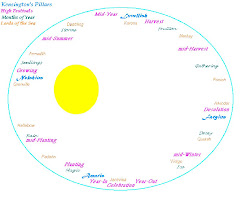
* The Great Sea's calendar year was 396 days divided into eight months of 48 days each and 12 days which were not part of any month. Each month had six 8-day weeks. Every week day had its own name, and each day of the year was also uniquely named. The year was structured so that every day had the same name every year. Thus, for someone born on Magday Calesen 3 in the year 340, their birthday in 341, 342, 343 and so forth would remain Magday Calesen 3.
Wednesday, December 10, 2008
The Elves
The Elves were not listed in my posting "The Free People" because at the beginning there were no Elves. The Elves were the result of the union between Massimo, last of the Nomads, and Elva, last of the Pennans.
There is an unfinished story of how Massimo was captured by Barbarians. His tribe was wiped out. He was taken as a gladiator, to fight for the amusement of others in a circus environment. While at his prison he met Elva, who had also been taken prisoner. Her task was to provide musical entertainment. With them was Hondu, last of the Mortals, who's task it was to perform 'magic' tricks. (Mortals were Children of Fire who had taken mortal form in order to help the various Races recover from the Great War. Hondu had chosen to be a Figgit.) Hondu had the power to free himself whenever he wanted, but he was waiting. When Massimo arrived, he knew what he was waiting for and arranged for Elva and Massimo to escape with him. Pursued by Barbarians, Hondu led Elva and Massimo into the mountains where, at long last, Hondu's mortality came to an end. Before he died he gave the power he had accumulated evenly to Elva and Massimo, thereby binding them as wife and husband. He also was able to arrange their escape from the world.
When Elva and Massimo reached their new world they remained in hiding. Hondu had warned them they were not only at risk from Barbarians. Should the Warlords learn the significance of their union, they would seek their deaths. (Warlords were Children of Fire. They were powerful beings who sought to take control of the Sea.) So they lived on the slopes of a mountain range, and there they had their children, and their children had their children. The children called themselves, Elva's Children. Over time this became shortened to Elva's, and eventually Elves.
What made Elva and Massimo's union so special was Hondu's giving them his Power. The Mortals were granted the knowledge of when they would die. Shortly before death they would 'pass on' their Power to another Mortal. This resulted in a consolidation of Power until, finally, Hondu had all of the Power of all of the Mortals. Hondu gave this to Elva and Massimo, knowing that by doing so, he had made the decision on where Madatar would come from.
Eventually, as the Elves' population increased, the Warlords did come to notice them, and they did understand the significance of their origins. And so began the Warlords' persecution of the Elves. Their fear of Madatar hindered their efforts, and because of that the Elves survived. Eventually, they would become scattered across the Sea, awaiting the coming of Madatar. For some, the years had been few when Madatar finally came. For others, it had been so long they had forgotten about him.
There is an unfinished story of how Massimo was captured by Barbarians. His tribe was wiped out. He was taken as a gladiator, to fight for the amusement of others in a circus environment. While at his prison he met Elva, who had also been taken prisoner. Her task was to provide musical entertainment. With them was Hondu, last of the Mortals, who's task it was to perform 'magic' tricks. (Mortals were Children of Fire who had taken mortal form in order to help the various Races recover from the Great War. Hondu had chosen to be a Figgit.) Hondu had the power to free himself whenever he wanted, but he was waiting. When Massimo arrived, he knew what he was waiting for and arranged for Elva and Massimo to escape with him. Pursued by Barbarians, Hondu led Elva and Massimo into the mountains where, at long last, Hondu's mortality came to an end. Before he died he gave the power he had accumulated evenly to Elva and Massimo, thereby binding them as wife and husband. He also was able to arrange their escape from the world.
When Elva and Massimo reached their new world they remained in hiding. Hondu had warned them they were not only at risk from Barbarians. Should the Warlords learn the significance of their union, they would seek their deaths. (Warlords were Children of Fire. They were powerful beings who sought to take control of the Sea.) So they lived on the slopes of a mountain range, and there they had their children, and their children had their children. The children called themselves, Elva's Children. Over time this became shortened to Elva's, and eventually Elves.
What made Elva and Massimo's union so special was Hondu's giving them his Power. The Mortals were granted the knowledge of when they would die. Shortly before death they would 'pass on' their Power to another Mortal. This resulted in a consolidation of Power until, finally, Hondu had all of the Power of all of the Mortals. Hondu gave this to Elva and Massimo, knowing that by doing so, he had made the decision on where Madatar would come from.
Eventually, as the Elves' population increased, the Warlords did come to notice them, and they did understand the significance of their origins. And so began the Warlords' persecution of the Elves. Their fear of Madatar hindered their efforts, and because of that the Elves survived. Eventually, they would become scattered across the Sea, awaiting the coming of Madatar. For some, the years had been few when Madatar finally came. For others, it had been so long they had forgotten about him.
Subscribe to:
Posts (Atom)